Skip to content

Chicago Social Justice

Chicago’s Fight for Fairness and Equality

  • Main
  • Community & Activism
  • Equity & Inclusion
  • Policy & Reform

Recent Posts

  • Culturally Responsive Education Programs in Chicago
  • Bridging the Digital Divide: Tech Access and Equity in Chicago
  • Advancing Women’s Leadership in Chicago Communities
  • Programs Promoting LGBTQ+ Visibility and Safety in Chicago
  • Immigration Justice: Programs Supporting Chicago’s Immigrant Populations

Tags

  • accessible housing Chicago
  • Access Living Chicago
  • ADA compliance Chicago
  • affordable housing Chicago
  • Chicago activism
  • Chicago communities
  • Chicago community activism
  • Chicago community engagement
  • chicago community organizing
  • Chicago community programs
  • Chicago grassroots movements
  • Chicago neighborhoods
  • chicago policy reform
  • Chicago reform efforts
  • Chicago social justice
  • chicago youth activism
  • civic engagement
  • civic engagement chicago
  • community activism Chicago
  • community advocacy Chicago
  • community development chicago
  • community empowerment
  • community organizing
  • criminal justice reform
  • criminal justice reform Chicago
  • economic justice Chicago
  • environmental justice Chicago
  • equity and inclusion
  • equity and inclusion Chicago
  • grassroots activism chicago
  • grassroots movements
  • grassroots movements Chicago
  • health equity Chicago
  • housing justice Chicago
  • immigrant rights
  • inclusion programs chicago
  • local activism Chicago
  • Mayor’s Office for People with Disabilities
  • peacekeepers program
  • police accountability Chicago
  • racial justice Chicago
  • restorative justice Chicago
  • social change in chicago
  • social justice Chicago
  • social justice in Chicago

Tag: civic engagement chicago

Advancing Women’s Leadership in Chicago Communities

On any given weekday evening in Chicago, leadership does not always look like a podium or a microphone. Sometimes it looks like a woman staying late at a community center to help a family fill out housing paperwork. Other times, it is a school volunteer organizing parents after dismissal, or a nonprofit director walking block to block to understand what a neighborhood truly needs. These moments rarely make headlines, yet they form the backbone of leadership across Chicago’s communities.

Women have long been shaping Chicago from the ground up. While political milestones and executive titles often receive attention, the city’s most enduring progress has come from women leading where daily life unfolds. In neighborhoods across the South Side, West Side, and beyond, women are building systems of support that address real needs with practical solutions.

Advancing Women’s Leadership in Chicago Communities

Leadership Rooted in Lived Experience

What distinguishes women’s leadership in Chicago is how deeply it is tied to lived experience. Many women leaders emerge not because they sought power, but because circumstances demanded action. They step forward to solve problems they encounter firsthand: underfunded schools, unsafe housing, lack of healthcare access, or limited job opportunities.

This form of leadership is grounded rather than abstract. It prioritizes listening before acting and collaboration over authority. Decisions are informed by conversations with neighbors, parents, elders, and youth. In communities where trust is essential, women leaders often serve as connectors, bridging gaps between residents, service providers, and institutions.

Navigating Barriers While Moving Forward

Despite their impact, women in Chicago continue to face obstacles when pursuing leadership roles. Gender bias, unequal pay, limited access to capital, and underrepresentation in decision-making spaces remain persistent challenges. These barriers are especially pronounced for women of color, immigrant women, and women from low-income neighborhoods.

Yet progress continues because many women refuse to wait for permission. Grassroots leadership programs, peer mentorship circles, and community-driven training initiatives have created pathways where formal systems fall short. These efforts focus on skill-building, confidence, and access to networks that make leadership sustainable rather than symbolic.

Women-Led Organizations Strengthening Neighborhoods

Across the city, women-led organizations are addressing some of Chicago’s most complex social issues. From housing advocacy and violence prevention to workforce development and public health, these organizations tend to operate with a long-term view. The goal is not quick fixes, but lasting stability.

Women leaders often design programs with flexibility in mind, understanding that community needs evolve. They rely on feedback from residents and adapt accordingly. This responsiveness builds trust and increases participation, making initiatives more effective and resilient over time.

Education as a Leadership Pipeline

Education has long been a space where women’s leadership flourishes. In Chicago, women educators, counselors, and administrators play a central role in shaping inclusive learning environments. Their influence extends beyond academics into social development, mental health support, and family engagement.

Many women leaders also focus intentionally on youth mentorship. Programs aimed at young girls emphasize leadership skills, self-advocacy, and civic awareness. By introducing leadership early, these initiatives help create a future generation that understands its power and responsibility within the community.

Civic Engagement and Local Advocacy

Women’s leadership in Chicago increasingly intersects with civic engagement. Women serve on local boards, neighborhood councils, and advisory committees where they help shape policy discussions. Their advocacy tends to center on everyday realities: safe transportation, childcare access, healthcare availability, and fair employment practices.

Rather than approaching policy from a distance, women leaders bring community stories directly into civic spaces. This approach humanizes policy decisions and strengthens accountability. It also encourages greater participation from residents who may have felt excluded from traditional political processes.

Embracing Intersectional Leadership

Advancing women’s leadership requires acknowledging the diversity within women’s experiences. Effective leadership initiatives recognize differences in race, culture, age, ability, and identity. Chicago’s most impactful programs prioritize inclusion, ensuring that leadership opportunities reflect the city’s full spectrum of voices.

Intersectional leadership does more than broaden representation. It improves outcomes by incorporating multiple perspectives into decision-making. When leadership reflects the community it serves, solutions become more relevant and sustainable.

Sustaining Progress Through Support and Visibility

The future of women’s leadership in Chicago depends on consistent investment and recognition. Access to funding, leadership training, and institutional support allows women leaders to expand their impact without burnout. Visibility also matters. Sharing stories of women leading in neighborhoods helps shift public perception of what leadership looks like.

Celebrating leadership at all levels reinforces the idea that leadership is not limited to formal titles. In Chicago, leadership often appears as persistence, problem-solving, and collective care.

source: TEDx Talks

Why Women’s Leadership Shapes Chicago’s Future

Communities led by women tend to be more connected, adaptable, and resilient. Women leaders bring empathy alongside strategy, balancing immediate needs with long-term goals. Their leadership strengthens social infrastructure, improves service delivery, and fosters collaboration across sectors.

As Chicago continues to confront challenges related to equity, housing, education, and economic opportunity, women’s leadership remains essential. Supporting women leaders is not simply a matter of fairness. It is a commitment to building neighborhoods that are stronger, more responsive, and better prepared for the future.

The written content on this page was generated by ChatGPT.
Posted on January 21, 2026January 21, 2026Categories Equity & InclusionTags Chicago activism, Chicago communities, civic engagement chicago, community development chicago, community leadership, equity and inclusion, gender equity, grassroots leadership, intersectional leadership, local advocacy Chicago, nonprofit leadership Chicago, social justice in Chicago, women in leadership, women-led organizations, women’s leadership

How Art Installations Promote Social Awareness in Chicago

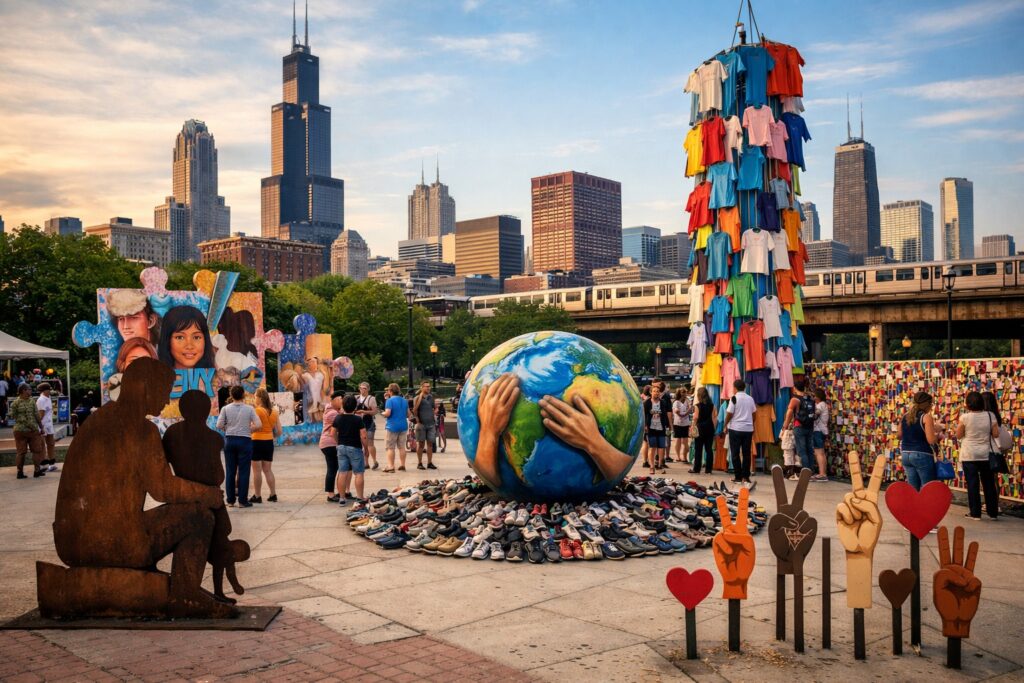
When walking through the streets of Chicago, it’s impossible not to notice the vibrant murals, sculptures, and public art pieces that define the city’s neighborhoods. But beyond their visual appeal, many of these installations carry a deeper purpose: they challenge the community to think critically about social issues, spark conversations about inequality, and inspire collective action. In Chicago, a city known for its cultural richness and diversity, art has become more than decoration—it is a tool for social awareness, civic engagement, and community transformation.

How Art Installations Promote Social Awareness in Chicago

The Transformative Power of Public Art

Art is uniquely capable of reaching people on an emotional level. Unlike academic reports or policy statements, public art engages individuals directly, prompting reflection and dialogue in a way that feels personal and immediate. In Chicago, artists are increasingly leveraging this power to address pressing social issues, from racial justice to environmental concerns. These installations serve as both mirrors and megaphones—reflecting community experiences while amplifying voices that often go unheard.

Public art’s accessibility is one of its greatest strengths. Unlike gallery exhibits that may be limited to certain audiences, murals, sculptures, and interactive installations exist in public spaces, making social commentary available to anyone who passes by. This democratization of art allows people from all walks of life to encounter, interpret, and react to social issues in real time.

Chicago Neighborhoods Leading the Way

Pilsen’s Murals: Celebrating Heritage and Challenging Inequality

The Pilsen neighborhood is renowned for its colorful murals that celebrate Mexican-American heritage while simultaneously highlighting social challenges like gentrification and cultural erasure. Artists such as Jesse Rodriguez and Arturo Blanco use walls as canvases to tell stories of community resilience, resistance, and pride. Each mural acts as a visual dialogue with the neighborhood, encouraging residents to reflect on the community’s past while engaging with its present challenges.

The South Side’s “Wall of Resilience”

On Chicago’s South Side, the Wall of Resilience stands as a testament to community strength. The installation features portraits, stories, and symbols that honor residents’ efforts to overcome adversity, from economic struggles to systemic inequities. This piece not only documents history but also inspires ongoing civic participation, demonstrating how art can celebrate human endurance while motivating continued advocacy.

Interactive Installations for Civic Engagement

Projects like the “Raise Your Voice” installation in Grant Park take public engagement a step further. Visitors are invited to contribute their personal reflections and experiences, creating a collective tapestry of voices. By interacting with the piece, participants gain a tangible understanding of community dynamics, empathy for others’ experiences, and a sense of agency in shaping social change.

Addressing Environmental and Social Justice

Chicago’s art scene is increasingly tackling environmental issues, particularly in neighborhoods affected by industrial pollution and climate vulnerability. Sculptures and installations made from recycled or reclaimed materials highlight the city’s ecological challenges, from air quality concerns to waste management issues. These works serve as visual catalysts for awareness, prompting residents to consider sustainable practices while also pressuring policymakers to prioritize environmental justice.

Similarly, public art has become a platform for amplifying marginalized voices. Artists from underrepresented communities use installations to share their experiences with systemic inequities, whether related to race, gender, disability, or immigration. By embedding these narratives into public spaces, art transforms ordinary streets and parks into forums for dialogue, education, and empowerment.

Building Community Through Art

One of the most remarkable aspects of socially-conscious art is its ability to foster community collaboration. Many installations involve residents directly, whether through participatory mural projects, community workshops, or collaborative sculpture construction. This participatory process nurtures a sense of belonging, encourages civic pride, and strengthens social bonds.

Furthermore, these projects often serve as educational tools. Schools, local organizations, and community centers integrate public art into lessons about history, social justice, and civic responsibility. Students learn not only about artistic techniques but also about the societal issues the art addresses, creating a new generation of socially-conscious citizens.

Art as a Catalyst for Policy Change

While art often starts as a form of expression, its impact can extend into the realm of policy and social reform. Installations that highlight housing inequality, environmental hazards, or public safety issues can raise awareness that influences city policies. For example, community engagement with environmentally-focused art has prompted local initiatives for cleaner streets, better waste management, and equitable green spaces.

By offering a platform for dialogue and visibility, public art ensures that community concerns reach a broader audience, including policymakers and civic leaders. It creates a space where residents’ voices are heard, often leading to tangible changes in social programs, legislation, and city planning.

Looking Ahead: The Future of Socially-Conscious Art in Chicago

Chicago continues to support and expand socially-conscious art through public funding, nonprofit initiatives, and neighborhood programs. Grants and community arts funds encourage artists to tackle pressing social issues, ensuring that public spaces remain sites of engagement and empowerment.

As the city evolves, socially-conscious art will continue to play a critical role in bridging gaps between communities, policymakers, and the public. By merging creativity with civic engagement, Chicago demonstrates how art can be a powerful tool for fostering awareness, empathy, and tangible social change.

source: Earth Art Chicago

Chicago’s public art scene is a vivid reminder that art is not just an aesthetic pursuit—it is a force for awareness, dialogue, and action. From murals celebrating heritage to interactive installations promoting civic engagement, these projects educate, inspire, and mobilize communities around critical social issues.

For residents and visitors alike, exploring Chicago’s socially-conscious art offers more than visual enjoyment; it provides insight into the city’s ongoing struggles and triumphs in promoting equity, justice, and inclusion. By engaging with these installations, individuals become part of a broader conversation, one that transforms streets, neighborhoods, and ultimately the city itself.

The written content on this page was generated by ChatGPT.

Posted on December 21, 2025December 21, 2025Categories MainTags Activism through art, Art installations Chicago, Art promoting equity in Chicago, Chicago murals, Chicago public art, civic engagement chicago, Community art Chicago, Cultural heritage murals Chicago, Environmental art Chicago, Interactive art installations Chicago, Neighborhood art projects, Public art for social change, Social awareness through art, Social justice art Chicago, South Side Chicago community art

Voting Rights and Civic Engagement in Chicago: How Everyday People Are Keeping Democracy Alive

In Chicago, civic life has always been more than just politics—it’s a living, breathing expression of community identity. On any given day, you can find neighbors gathering at local schools, community centers, or church basements, talking about the future of their city. Some are discussing a new housing ordinance; others are sharing reminders about where to vote. That kind of local energy—ordinary people caring about collective decisions—is the heartbeat of democracy.

But behind that familiar hum of civic spirit lies a longer, more complicated story. Chicago’s path toward equal voting rights and true civic engagement has never been simple. It’s a story marked by resilience, struggle, and an ongoing effort to make sure every resident’s voice is heard—and counted.

Voting Rights and Civic Engagement in Chicago: How Everyday People Are Keeping Democracy Alive

A Historical City of Voices and Struggles

Chicago’s connection to democracy goes back generations. The city has witnessed labor uprisings, civil rights marches, and political reform movements that reshaped the nation. Yet, beneath the slogans and speeches, there were always communities fighting quietly for access—to fair representation, equal treatment, and the right to participate without obstruction.

In the early to mid-20th century, Chicago’s political machine often dictated who held influence. While some benefited from strong political networks, others—particularly Black, Latino, immigrant, and low-income residents—found their political power restricted. Redistricting tactics and voter intimidation in certain wards were once commonplace. Still, the determination to participate in civic life never disappeared.

During the 1960s, local civil rights groups took inspiration from national leaders but built distinctly Chicago-based movements. The Chicago Freedom Movement, led by Dr. Martin Luther King Jr. and local activists, demanded not only fair housing but also recognition of political power in neighborhoods that had long been overlooked. This moment reignited the idea that civic participation wasn’t a privilege; it was a necessity.


Modern-Day Challenges to Voter Access

Fast forward to today, and the conversation around voting rights has evolved—but the core issues remain familiar. Accessibility, education, and representation still define the debate. Many residents in Chicago’s South and West Sides face practical barriers to voting: limited polling sites, long travel distances, and lack of flexible voting hours that accommodate working-class schedules.

Language barriers persist, especially among immigrant populations. While the Chicago Board of Elections has expanded multilingual materials, outreach still doesn’t reach everyone. Others face digital barriers—difficulty finding accurate information about registration or deadlines online.

Grassroots organizations have stepped in to close these gaps. Groups like Chicago Votes, Change Illinois, and Illinois Coalition for Immigrant and Refugee Rights have transformed civic engagement from a bureaucratic process into a community-driven effort. They host registration events in schools, prisons, libraries, and even music festivals—meeting people where they are, both physically and culturally.


Youth Power: Redefining Civic Participation

Perhaps the most encouraging change in recent years is the surge of youth-led civic action. Young Chicagoans are proving that engagement doesn’t begin at age eighteen—it begins with awareness and a sense of belonging.

High school students have formed voter education clubs, while college campuses across the city have become hotbeds for political organizing. Social media plays a major role here, with short, creative videos breaking down ballot measures, election dates, and registration tips.

This generation sees civic duty through a wider lens: environmental sustainability, criminal justice reform, gender equity, and mental health care all tie back to policy. For many of them, activism and voting are two sides of the same coin.


Representation and Reform at the Local Level

Chicago’s diversity—ethnically, economically, and culturally—means that the city’s democracy must be constantly reimagined. The fight for equitable representation has recently taken center stage as advocates push for fair redistricting maps that truly reflect neighborhood demographics.

City officials and civic organizations have also worked together to improve early voting options, implement mobile polling sites, and expand mail-in ballot accessibility. These may seem like technical updates, but for many Chicagoans—especially seniors, people with disabilities, and those without reliable transportation—they represent critical steps toward inclusion.

What’s emerging is a more flexible and human-centered voting process. The city’s approach now emphasizes that participation should be convenient, secure, and inclusive rather than intimidating or confusing.


Civic Engagement Beyond Election Day

While elections grab the headlines, the real engine of Chicago’s democracy hums quietly year-round. Residents join block clubs, attend city council meetings, and volunteer at community centers. These acts of everyday engagement may not make the evening news, but they are where civic identity takes root.

In neighborhoods like Bronzeville, Little Village, and Uptown, community-driven projects tackle issues ranging from food insecurity to environmental justice. Many of these initiatives begin as local concerns but often evolve into political advocacy. Civic engagement, in this sense, becomes a continuum—starting with conversation and culminating in collective action.

Digital activism has added another layer to this process. Online petitions, neighborhood Facebook groups, and grassroots fundraising efforts have made participation more immediate and accessible. Chicagoans are now engaging in democracy not just at the ballot box but in their timelines, inboxes, and comment threads.


Education: The Foundation of Lasting Participation

Civic education is a critical piece of the puzzle. In many ways, Chicago’s future depends on how well its residents—especially young people—understand their role in shaping it. Schools and local nonprofits are reviving civics programs that go beyond memorizing government structures. They’re helping students see the direct link between voting and tangible change: better transit, safer streets, cleaner parks.

Programs like Civics in the Middle and Student Voice Committees encourage students to ask hard questions and explore how policies affect their communities. Some schools even simulate mock elections, allowing students to experience firsthand how their voices can drive decisions. These lessons create not just informed voters, but confident community leaders.


Confronting Cynicism and Rebuilding Trust

Still, civic participation in Chicago faces one persistent obstacle: public cynicism. After decades of political scandals and systemic inequality, many residents remain skeptical that their votes can bring meaningful change. For some, disengagement feels easier than disappointment.

But hope often returns at the community level. When residents see their neighbors organizing, when they witness a local park renovation or a policy shift that began with public pressure, faith in democracy begins to rebuild. Civic engagement thrives on visibility—when people see results, they find reason to stay involved.

Organizations that prioritize transparency, accountability, and two-way communication with residents are essential in maintaining that trust. The goal isn’t just to get people to vote—it’s to show them why participation matters long after the election ends.

source: Presidential Precinct

The Road Ahead: A City Still Finding Its Voice

Chicago’s journey toward equitable democracy is far from complete, but it’s moving forward—driven by communities that refuse to give up their seat at the table. From the South Side to Rogers Park, from new citizens registering to vote for the first time to lifelong activists mentoring the next generation, civic engagement remains one of the city’s most enduring traditions.

Every ballot cast, every meeting attended, every petition signed contributes to a larger narrative: a city determined to make democracy not just a system, but a shared responsibility.

Voting rights are not merely political—they’re personal. They speak to identity, dignity, and belonging. And in a city built by dreamers, laborers, and reformers, that belief continues to guide Chicago toward a more inclusive, participatory future.

The written content on this page was generated by ChatGPT.

Posted on October 12, 2025October 13, 2025Categories Policy & ReformTags Chicago activism, Chicago community engagement, chicago democracy, chicago politics, chicago social justice blog, chicago voter registration, chicago voting rights, civic engagement chicago, civic participation, community organizing, equity and inclusion, grassroots movements, policy reform chicago, social justice Chicago, voter education, voting access chicago
Proudly powered by WordPress