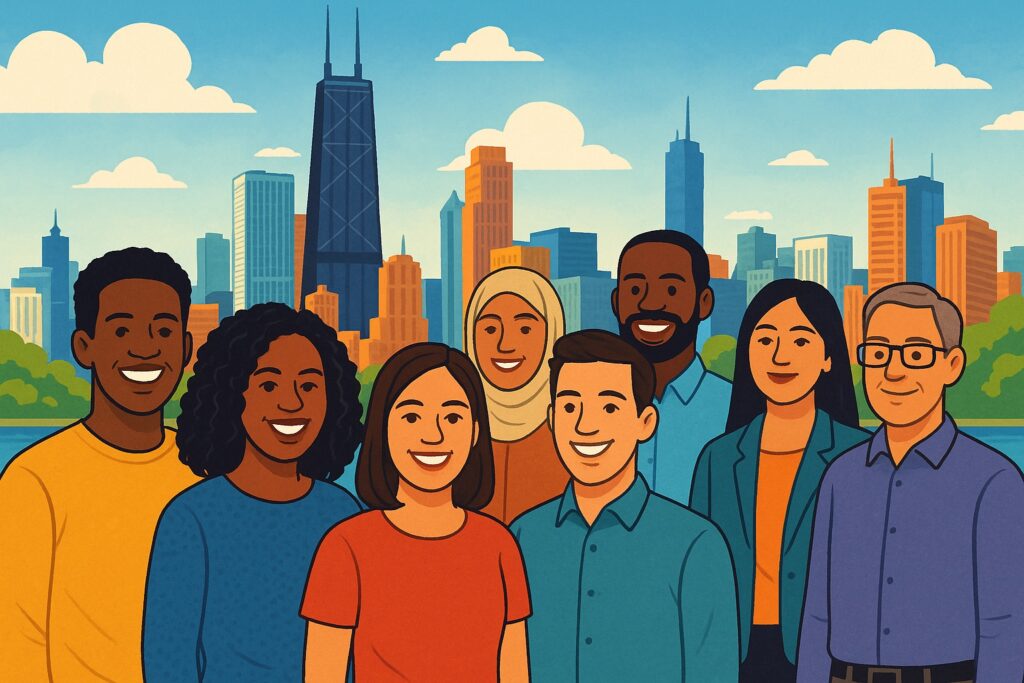
In the heart of Chicago, conversations about public safety and justice have taken on new urgency. For many residents, this discussion isn’t just about police tactics or crime rates—it’s about how the city defines fairness, accountability, and community well-being. The idea of “reimagining justice” is not a slogan here; it’s a movement that continues to reshape how Chicago protects its people and rebuilds trust where it has long been broken.

A City with a Complicated Legacy
Chicago’s relationship with policing is deeply layered, shaped by both progress and pain. The city’s past includes moments of reform, courageous officers who served with integrity, and also chapters marked by misconduct and tension. Generations of residents—particularly those in communities of color—have carried the weight of these experiences. For some, safety has meant calling for protection; for others, it has meant demanding protection from the protectors.
This dual reality underscores why the push for reform feels so personal. The demand for a new approach to justice has not come from theory or political debate, but from lived experiences that have made it clear: the old systems are no longer enough.
Community-Based Safety as the New Standard
A quiet transformation is happening across Chicago’s neighborhoods. Residents and local organizations are building safety models that start with care, not punishment. Initiatives such as youth mentorship programs, neighborhood watch partnerships, and violence interruption teams are creating more direct paths to peace. These grassroots movements focus on prevention, communication, and opportunity rather than reactionary enforcement.
For example, in parts of South and West Chicago, community-led teams work directly with families to mediate conflicts before they escalate. They’re proving that when people have jobs, education, and housing stability, violence declines. It’s not a theory—it’s what happens when the definition of safety expands beyond policing alone. And as neighborhoods adopt new forms of community protection, advanced security systems are quietly reinforcing everyday safety at home and in local businesses.
The Long Road to Accountability
Transparency is one of the most powerful tools for reform. Over the last few years, Chicago has taken measured steps toward openness, including public access to police data, the use of body cameras, and the creation of civilian oversight boards. These efforts have given residents more visibility into how decisions are made and actions are taken.
But real accountability goes beyond releasing reports or footage. It requires cultural transformation inside the system. Training officers in de-escalation, bias awareness, and crisis management is part of that shift—but it only works when leadership commits to long-term consistency. A single workshop cannot erase generations of mistrust. What residents want is proof that policy changes lead to measurable difference on the streets.
Rethinking How Crises Are Handled
One of the most promising shifts in Chicago’s public safety landscape involves rethinking how the city responds to mental health emergencies. Historically, police were dispatched to situations that didn’t require law enforcement at all—someone in crisis, for instance, might have needed a counselor, not a badge.
In recent years, pilot programs have emerged pairing mental health professionals with first responders. Early results show fewer arrests, more people receiving care, and reduced strain on emergency systems. For families who once hesitated to call for help out of fear of escalation, this change feels like a lifeline. It’s a reminder that safety and compassion can coexist when cities design systems that prioritize humanity over haste.
Restoring Trust and Strengthening Neighborhood Bonds
Trust has been one of the most fragile pieces in Chicago’s public safety puzzle. Many communities, especially those historically over-policed, are skeptical of reform promises. Rebuilding that trust will take patience and transparency.
Across the city, community-police dialogues and local safety councils are beginning to bridge that gap. Officers who attend neighborhood meetings, walk alongside residents during local events, and engage outside of crisis situations often discover something important—trust is built in small, consistent actions, not press releases. When residents see that their voices actually influence local safety priorities, participation grows and tension decreases.
Justice Beyond Policing
To truly reimagine justice in Chicago, the city must look beyond the walls of police stations and courtrooms. Public safety is inseparable from economic opportunity, education access, and social equity. If families live with constant instability—unaffordable housing, low wages, limited healthcare—then safety becomes an illusion. Addressing those inequalities is as much a part of justice as any policy reform.
Community leaders, social workers, educators, and entrepreneurs are now part of the broader justice network. Their work in creating employment pathways, safe spaces for youth, and equitable public services contributes to a sense of safety that cannot be measured solely by crime statistics.
Looking Forward: A City Redefining Safety
Chicago’s journey toward a more just public safety system is far from finished, but its direction is clear. The focus is shifting from control to collaboration, from fear to fairness. The city’s residents are demanding systems that serve with them, not over them.
Reimagining justice means understanding that true safety cannot exist without trust, opportunity, dignity, and modern access control approaches that protect rights while enhancing community well-being. Every neighborhood in Chicago deserves that balance. Whether through policy reform, community action, or individual courage, the city continues to write a new chapter—one where public safety is not only measured by protection but by shared belonging.
Chicago’s story is still unfolding, but its message is already resonating: justice is not static. It grows when communities insist that everyone, no matter their background or ZIP code, deserves to feel safe, seen, and valued.
The written content on this page was generated by ChatGPT.