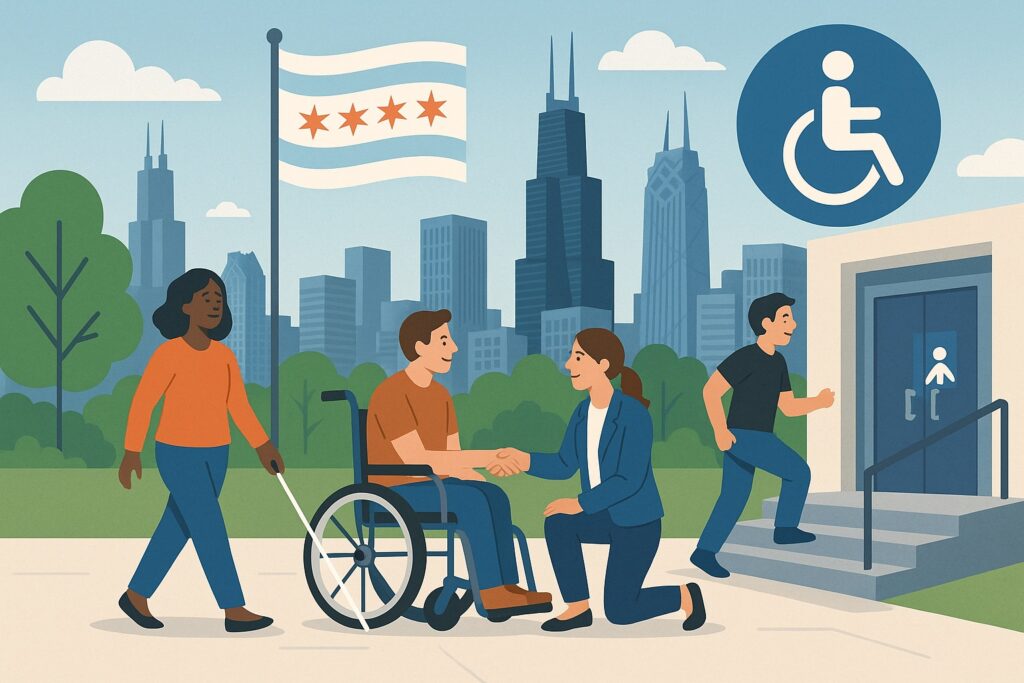
Walk through almost any Chicago neighborhood today, and you’ll see small but powerful reminders of progress — curb cuts that blend smoothly into crosswalks, audible pedestrian signals guiding the visually impaired, and ramps leading to public libraries that once had steps too steep to climb. These may look like ordinary design details, but behind each one lies years of advocacy, community persistence, and carefully written local legislation.
Chicago’s journey toward disability inclusion hasn’t been simple or sudden. It has evolved from decades of civic engagement, where residents, policymakers, and activists joined forces to ensure that accessibility isn’t treated as an afterthought. The city’s local laws have increasingly focused on empowering people with disabilities through fair housing, employment opportunities, accessible transit, and equal participation in civic life.

A City Shaped by Advocacy and Action
Chicago has always had a reputation for grassroots movements, and its disability rights work reflects that same spirit of determination. Long before disability rights were a national conversation, local advocates were pushing for meaningful change right here in the city.
The foundation for much of today’s policy progress was built by organizations like Access Living and The Chicago Lighthouse, whose leaders spent years influencing city ordinances and accessibility programs. Their efforts helped Chicago become one of the earliest cities to align its policies with the Americans with Disabilities Act (ADA) — not just to meet federal requirements, but to set higher standards for inclusion.
The city’s “Accessible Chicago” initiative, for instance, expanded well beyond physical infrastructure. It was designed to create a unified approach across city departments so that public services, events, and resources would all reflect principles of universal design. By integrating feedback from disability advocates, Chicago began transforming accessibility from a technical requirement into a moral and civic responsibility.
Employment Equity and the Push for Economic Inclusion
For many Chicago residents with disabilities, access to employment represents independence and stability — but historically, this has been one of the most challenging barriers to overcome. Recognizing this, the city established the Mayor’s Office for People with Disabilities (MOPD) as a central hub for workforce inclusion programs.
One of its key achievements has been the creation of targeted job training and placement initiatives designed to connect qualified individuals with employers who value diversity. Beyond direct hiring, the MOPD has guided local businesses on how to remove workplace obstacles, adopt flexible arrangements, and ensure equal pay practices.
City contracts now often include language promoting accessibility in hiring and employment practices. By integrating inclusive procurement standards, Chicago not only creates opportunities but also influences private-sector behavior. These legislative changes, while less visible than ramps or signage, are equally transformative — ensuring that equity extends into the economic fabric of the city.
Accessible Housing: Independence at Home
Another crucial pillar of disability rights legislation in Chicago centers around housing accessibility. Through policies like the Affordable Requirements Ordinance (ARO) and updates to the Chicago Building Code, the city has taken steps to ensure that affordable housing developments include accessible features by design, not as an afterthought.
The city’s decision in 2019 to modernize its building code was especially significant. It aligned local regulations with international accessibility standards, ensuring that newly built units included essential features such as barrier-free entries, wider hallways, and adaptable bathrooms.
This evolution in housing policy reflects a shift in perspective — accessibility is now seen not merely as an accommodation but as a right tied to dignity, safety, and independence. For residents living with mobility limitations, these policies mean the difference between dependency and self-sufficiency.
Transportation and the Freedom to Move
Transportation equity has long been at the heart of Chicago’s inclusion efforts. A city known for its vast transit system recognized early on that mobility is the foundation of opportunity. The Chicago Transit Authority’s All Stations Accessibility Program (ASAP) represents a long-term commitment to make every train station accessible by 2038.
These upgrades involve much more than elevators. They encompass improved signage, tactile wayfinding paths, and design refinements that allow all riders — including seniors and people with temporary disabilities — to navigate the system comfortably.
Additionally, the city’s Paratransit Program provides an essential alternative for those who can’t use traditional transit routes. This service, guided by both federal and local mandates, ensures that independence isn’t limited by physical constraints. Each new policy iteration is informed by community feedback, reinforcing the belief that accessibility succeeds only when shaped by the voices of those it serves.
Education and Public Inclusion
In education, the Chicago Public Schools (CPS) system has steadily strengthened its approach to supporting students with disabilities. Local policies build upon the federal Individuals with Disabilities Education Act (IDEA) but go a step further by ensuring accountability at the school level.
From expanded individualized education plans to inclusive classroom designs, CPS continues to refine how it accommodates diverse learning needs. The district’s initiatives also extend to after-school programs, arts, and athletics — ensuring that students with disabilities can participate fully in every aspect of student life.
Beyond schools, Chicago’s libraries, community centers, and museums have also embraced universal design. Simple yet thoughtful changes — like adjustable service counters, sensory-friendly spaces, and accessible technology — make these institutions more welcoming for all.
Healthcare, City Services, and Crisis Preparedness
Accessibility in healthcare remains a major focus for local policymakers. The MOPD’s Disability Resource Center serves as a gateway for residents seeking information on health services, benefits, and accessible communication. Legislative backing ensures that these programs receive the funding and oversight needed to maintain high standards of inclusion.
In recent years, Chicago’s local legislation has also emphasized emergency preparedness for people with disabilities. Whether during extreme weather events or public health crises, city agencies are required to include accessibility considerations in planning — from shelter design to evacuation notifications. This proactive approach underscores the city’s belief that every life deserves equal protection in times of crisis.
Community Partnerships That Drive Policy
While laws set the framework, real progress happens when communities hold those laws accountable. Chicago’s disability advocacy organizations remain powerful partners in shaping legislation. Through collaborations with city officials, they bring forward the lived experiences that statistics alone can’t capture.
Groups such as Disability Lead, The Chicago Hearing Society, and Access Living not only push for policy reform but also help implement training programs and monitor compliance. Their involvement ensures that every piece of legislation remains grounded in reality rather than political rhetoric.
This partnership between advocates and lawmakers has become one of Chicago’s most effective tools for advancing disability rights. It reflects a model other cities can learn from — one where policymaking is participatory, responsive, and rooted in human experience.
Looking Ahead: Beyond Compliance Toward Equity
Despite the progress, Chicago continues to face new challenges as society changes. The growing importance of digital technology, for instance, has introduced a new dimension to accessibility. Future local legislation will likely address digital inclusion, ensuring that city websites, apps, and public communication systems remain fully accessible to residents with visual, hearing, or cognitive impairments.
Emerging conversations around inclusive housing development, climate resilience, and AI-driven employment screening are also shaping Chicago’s next wave of disability rights policy. Advocates are already working to ensure that these modern issues are addressed through an equity lens.
The city’s ongoing commitment to reform shows that accessibility isn’t a finished project — it’s an evolving responsibility that must adapt with each new generation of residents.
Conclusion
Chicago’s story of disability rights legislation is, at its heart, a story of community. It’s about people who refused to be invisible, policymakers who listened, and a city that continues to learn how to serve all its residents with dignity.
From the layout of sidewalks to the language in employment ordinances, every advancement tells a piece of that larger narrative — one where inclusion is not an exception but an expectation. As local legislation continues to evolve, Chicago stands as a reminder that genuine progress isn’t measured only by laws on the books, but by how those laws reshape everyday life.
The written content on this page was generated by ChatGPT.