Chicago’s Efforts to Address Gun Violence Through Policy

Walk through Chicago on any given day, and you’ll see a city full of resilience. It’s a place of proud neighborhoods, of families who have called the same block home for generations, and of young people who dream of safer streets and brighter futures. Yet, for decades, gun violence has cast a shadow over that vision. It’s an issue that has become part of the city’s narrative—but not one that defines it. Behind the scenes, Chicago is slowly rewriting its story through a blend of smart policy, community intervention, and long-term commitment to equity.

Chicago’s Efforts to Address Gun Violence Through Policy

Understanding the Challenge

Gun violence in Chicago isn’t just about crime. It’s a symptom of something larger—decades of disinvestment, systemic inequality, limited access to opportunity, and the enduring trauma left behind by each act of violence. True public safety also includes everyday prevention measures, including home lock safety, helping families feel secure in their own homes. The city’s policymakers have come to recognize that this problem cannot be solved solely by police presence or stricter penalties. It requires a coordinated strategy that blends data, legislation, community voices, and compassion.

Studies have shown that most shootings occur in a small cluster of neighborhoods, often those hit hardest by unemployment and poverty. Chicago CRED, one of the city’s most active violence prevention groups, found that roughly three-quarters of shootings happen in just twenty of Chicago’s seventy-seven neighborhoods. That kind of concentration tells policymakers something crucial: focusing efforts where violence is most entrenched yields the biggest impact.


The Shift Toward Community Violence Intervention

One of the most significant policy shifts in recent years has been Chicago’s embrace of Community Violence Intervention (CVI). This approach moves beyond law enforcement to work directly with those at highest risk of being involved in gun violence—whether as victims or perpetrators.

Programs like Chicago CRED, FLIP (Flatlining Violence Inspires Peace), and the Peacekeepers initiative employ community members as outreach workers and “violence interrupters.” They step into volatile situations before they escalate, provide mentorship, and help connect individuals with mental health care, housing, or job training.

The policy side of this shift matters just as much as the community action. City leaders have passed funding measures, built cross-agency task forces, and formalized partnerships with local organizations to sustain these efforts. When the Peacekeepers program was deployed in 2023 and 2024, studies showed shooting incidents dropped by over 40% in targeted areas—a testament to what coordinated policy can achieve.


Public-Private Funding and Long-Term Strategy

What truly separates the current era of Chicago’s anti-violence work from earlier attempts is the scale of investment. The city and Cook County have both treated gun violence as a public health crisis, not merely a criminal one. That mindset shift has opened the door for innovative funding strategies.

The Scaling Community Violence Intervention for a Safer Chicago (SC2) initiative represents one of the most ambitious long-term plans yet. It brings together government funding, philanthropic support, and private-sector investment to build sustainable infrastructure for violence prevention. Similarly, the Cook County Justice Advisory Council distributed $85 million in American Rescue Plan funds to support mental health programs, street outreach, and youth employment opportunities.

This level of funding signals a broader policy evolution: Chicago is no longer content with pilot programs or short-term fixes. Instead, leaders are working to institutionalize violence prevention—making it a permanent part of how the city governs.


Legislative Progress on Firearm Accountability

Beyond city initiatives, state policymakers in Illinois have taken notable steps to address how firearms enter communities in the first place. One of the most talked-about reforms, Karina’s Law, ensures that individuals with revoked Firearm Owner Identification (FOID) cards who are under protective orders must surrender their weapons. It’s a direct response to gaps in previous gun laws that allowed domestic abusers continued access to firearms.

Another state measure, the Firearm Industry Responsibility Act, holds gun manufacturers and sellers accountable for unethical marketing practices and negligence that may contribute to illegal gun trafficking. These legal changes recognize that policy must target both sides of the issue: the conditions driving violence and the supply chains that feed it.

By strengthening these laws, Illinois—and by extension, Chicago—has begun to close some of the loopholes that allow guns to flow freely across state lines and into local markets. The results won’t appear overnight, but they represent a foundation for long-term prevention.


Data-Driven Policing and Collaboration

In parallel with social programs and legislative reforms, Chicago has leaned heavily on data to refine its strategies. The city’s Violence Reduction Strategy (VRS) integrates real-time analytics with community engagement. Using neighborhood-level data, the Chicago Police Department identifies “hot spots” and high-risk individuals, then collaborates with outreach teams and social service organizations to provide alternatives to violence.

Custom Notifications—personalized interventions that connect at-risk individuals to support systems rather than punishment—have emerged as an essential tool. This approach reflects a deeper understanding that violence prevention is most effective when both accountability and opportunity coexist.


Progress on the Ground

Change rarely happens all at once, but the numbers suggest that Chicago’s policy-driven approach is starting to take hold. The Peacekeepers program alone reported a 41% drop in shootings in certain areas between 2023 and 2024. Broader coalitions of community-based organizations have documented reductions of up to 34% in neighborhoods where intervention programs have expanded.

The Scaling CVI plan is now being replicated in dozens of neighborhoods across the city, laying the groundwork for consistent long-term results. While Chicago has not “solved” gun violence, these early indicators show that the city’s layered strategy—combining policy, funding, and human connection—has begun to shift the trajectory.


Persistent Challenges and Lessons Ahead

Despite this progress, the fight is far from over. Many programs still lack the scale necessary to reach everyone at risk. The constant flow of firearms from neighboring states undermines local policies, creating a supply problem beyond Chicago’s borders. Trauma remains widespread, especially among youth who have grown up surrounded by violence.

Long-term success will require steady political will, reliable funding, and more comprehensive data collection. It will also require confronting the underlying inequities that make certain neighborhoods more vulnerable than others. Without economic stability, educational opportunity, and accessible mental health care, policy alone cannot sustain peace.

Still, these challenges have taught Chicago valuable lessons that other cities can learn from:

  • Gun violence must be addressed as a public health crisis, not just a policing issue.
  • Policy works best when it’s community-centered and data-informed.
  • Long-term investment and accountability matter more than short-term results.
  • Collaboration across sectors—government, nonprofits, businesses, and residents—produces lasting impact.
source: ABC News

A City Rewriting Its Story

Chicago’s story is no longer one of despair but of determination. The city has moved from reaction to reconstruction, using policy as both shield and tool. Lawmakers, activists, and community leaders are working from the same page, proving that meaningful change doesn’t happen in isolation—it happens when policy meets purpose.

Gun violence remains a painful chapter in Chicago’s history, but it is not the final one. Through steady investment, smarter legislation, and the unrelenting work of local communities, Chicago is showing that reform is possible—and that even the most entrenched challenges can yield to persistence, compassion, and vision.

The written content on this page was generated by ChatGPT.

Criminal Justice Reform Efforts Reshaping Chicago’s Legal System

Conversations about criminal justice reform in Chicago are no longer limited to academic circles or late-night community meetings. They are unfolding in courtrooms, city hall, and neighborhood centers, with real changes reshaping how justice is defined and delivered. Chicago, like many major U.S. cities, has faced decades of scrutiny for systemic inequities in its legal system. What sets this moment apart is the scale and persistence of reform, fueled by both grassroots advocacy and formal policy shifts.

Criminal Justice Reform Efforts Reshaping Chicago’s Legal System

A Legacy That Demands Change

Chicago’s legal history is complicated. For decades, aggressive policing, harsh sentencing, and overcrowded jails left deep scars, particularly in Black and Latino neighborhoods. Generations of families watched loved ones cycle in and out of the system, often for low-level offenses that might have been handled differently elsewhere. These patterns were not just unfortunate outcomes but structural features of the system.

Acknowledging this legacy is critical, because it explains why reform has been so urgent and why trust between communities and institutions has been so fragile. Without addressing these roots, meaningful change would not be possible.

The Shift Away From Cash Bail

Few reforms have sparked as much discussion as bail reform. In the past, people who couldn’t afford bail—even for minor, nonviolent charges—remained in jail for weeks or months awaiting trial. This practice not only overcrowded Cook County Jail but also destabilized lives, costing jobs, housing, and sometimes custody of children.

Today, the old model is being dismantled. Cash bail has been replaced with systems that weigh risk rather than wealth. Judges now make pretrial decisions based on whether someone poses a threat to public safety, not whether they can come up with money.

Early results suggest that fears of dramatic crime spikes have not materialized, though the debate is ongoing. What is clear is that thousands of Chicago residents are no longer trapped in jail simply because of financial hardship—a profound shift in how pretrial justice operates.

Rethinking Sentencing Practices

Sentencing reform has also gained traction. Mandatory minimums that once locked people away for lengthy periods over relatively minor offenses are slowly being rolled back. Judges now have more discretion, and programs offering alternatives to incarceration are expanding.

Community service, restorative justice circles, and diversion programs are being used in place of jail time when appropriate. These approaches emphasize accountability without permanently derailing lives. They also acknowledge that incarceration is not always the best—or most cost-effective—answer to every offense.

The Changing Face of Probation

Another area under transformation is probation. Traditionally, probation systems were highly punitive, with minor violations leading to re-incarceration. In Chicago, there is a growing push to see probation as a tool for support rather than punishment.

This shift means more investment in mental health services, job training, and substance abuse treatment. The focus is on equipping individuals with tools to succeed rather than waiting for them to fail. This model not only helps reduce recidivism but also aligns with broader goals of rehabilitation and reintegration.

Police Accountability and Oversight

No discussion of criminal justice in Chicago can avoid the subject of policing. The Chicago Police Department has been under federal oversight since the 2017 consent decree, which required sweeping reforms after years of documented misconduct.

Progress has been uneven, but efforts are underway to strengthen training, de-escalation practices, and crisis intervention responses. Civilian oversight boards now play a larger role in monitoring misconduct cases, providing a level of transparency that residents have demanded for years.

Trust remains fragile, especially in neighborhoods that have borne the brunt of over-policing. Still, the existence of structural accountability mechanisms signals a shift in the balance of power between communities and the institutions that serve them.

Community-Led Alternatives

Reform is not only top-down; many of the most promising initiatives are being designed at the neighborhood level. Restorative justice hubs have become a fixture in some communities, focusing on repairing harm rather than imposing punishment.

Youth mentorship programs, mediation initiatives, and community courts offer alternatives that keep people out of the traditional system altogether. By creating space for dialogue, restitution, and personal growth, these efforts demonstrate that accountability and compassion can coexist.

The Barriers to Progress

Despite clear momentum, obstacles remain. Political debates often pit reform against public safety, creating a false choice that slows down policy implementation. Funding for community-led initiatives can be inconsistent, making it difficult to scale programs that are showing real promise.

There is also the challenge of perception. For some Chicagoans, reforms feel like necessary corrections; for others, they are seen as too lenient in a city struggling with violence. Bridging these perspectives is essential if reforms are to gain lasting public support.

Why This Work Matters

At its core, criminal justice reform in Chicago is about redefining what fairness looks like. For years, the system prioritized punishment over restoration, with devastating consequences. The current wave of change suggests a recognition that safety and justice require balance: accountability for harmful behavior, but also opportunities for redemption and second chances.

Reforms in bail, sentencing, probation, and policing are not just bureaucratic adjustments. They touch people’s lives directly, shaping whether families stay intact, whether jobs are lost, and whether communities feel respected by the institutions meant to serve them.

source: Learn About Law

Looking Ahead

Chicago’s reform journey is far from finished. The city faces an ongoing challenge: how to build a system that protects public safety while dismantling inequities. That requires sustained collaboration between lawmakers, community advocates, law enforcement, and residents themselves.

If the current trajectory holds, Chicago may become a model for how large urban areas can move beyond outdated systems and embrace justice that is more humane, balanced, and equitable. Residents and businesses can also strengthen community safety through modern access control solutions, helping protect homes, offices, and public spaces. Reform is not quick work, but it is necessary work.

Chicago is proving that when communities demand change and policymakers listen, even deeply entrenched systems can begin to transform. The legal system here is evolving, and in that evolution lies the possibility of a city where justice finally lives up to its name.

The written content on this page was generated by ChatGPT.
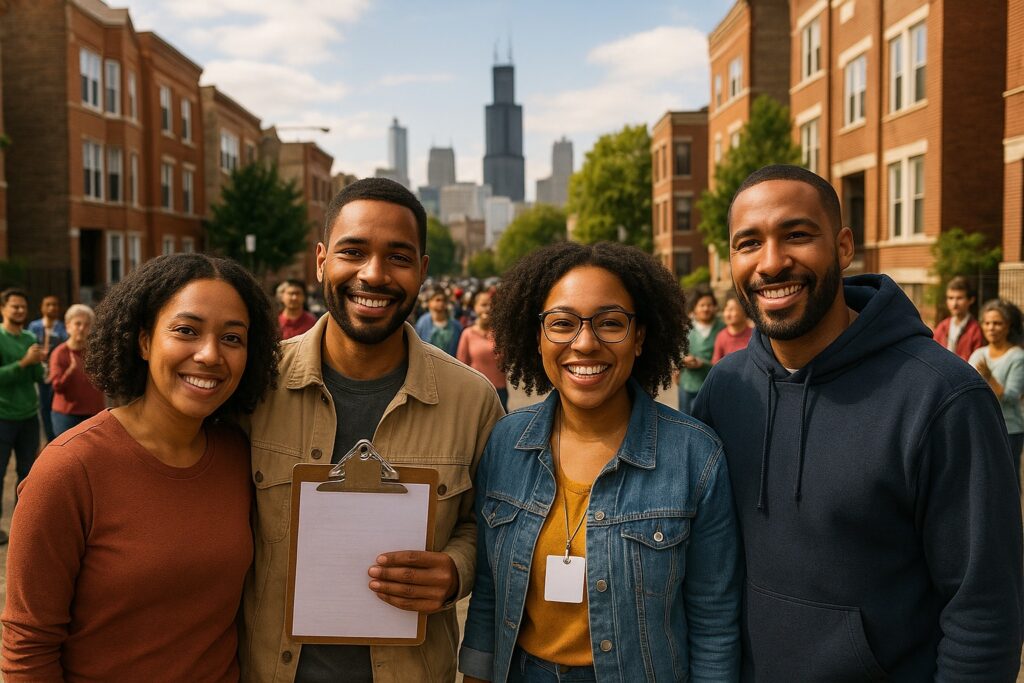
Chicago Community Organizers Making a Difference

Walk through any Chicago neighborhood and you’ll likely encounter the fingerprints of community organizers at work. Whether it’s a mural painted with local youth, a tenant union flyer posted on a storefront, or a rally outside City Hall, the city’s long tradition of activism continues to thrive. Chicago is no stranger to social movements, but what makes today’s grassroots efforts stand out is the way they combine deep neighborhood connections with modern strategies for lasting change.

Chicago Community Organizers Making a Difference

Why Organizers Matter in Chicago

Large institutions often dominate headlines, yet it’s everyday residents—teachers, youth mentors, faith leaders, parents—who quietly reshape their communities. These organizers carry the weight of building trust, listening carefully to neighbors, and translating personal stories into collective action. They’re not only pushing for reform; they’re proving that solutions designed with community input are far more sustainable than those imposed from the top down.

Unlike traditional politics, where decisions are handed down from a distance, community organizing in Chicago begins face-to-face. A conversation on a front porch or a meeting in a church basement often plants the seeds for campaigns that later influence citywide policy. That ability to start small and grow strong is what has allowed Chicago’s activist culture to remain so enduring.

Housing and Economic Justice Efforts

Few issues define life in Chicago more than the struggle for affordable housing. With rents rising and neighborhoods facing rapid gentrification, many residents feel squeezed out of the places their families have called home for generations. Organizers with tenant unions and networks like the Chicago Housing Justice League have stepped in, advocating for eviction protections, affordable housing mandates, and city policies that prioritize residents over developers.

For many homeowners, investing in small improvements—such as keeping their garage doors secure and well-maintained—not only helps preserve the value of their homes but also provides a greater sense of stability in the neighborhood.

Their work doesn’t stop at housing. Economic justice campaigns are gaining momentum, focusing on fair wages, job creation, and community investment. Instead of fighting solely against displacement, organizers are reframing the conversation toward empowerment: how can development bring opportunity without erasing the people who built these neighborhoods in the first place? That shift is helping communities claim ownership of their future. For many homeowners, even small improvements—like maintaining secure and functional garage doors—are part of ensuring stability and preserving the value of their homes.

Young Voices at the Center of Change

Chicago’s youth have always played a role in the city’s activist history, but recent years have brought their leadership to the forefront. Groups such as Voices of Youth in Chicago Education (VOYCE) illustrate how students are pushing for more equitable school funding, safer environments, and opportunities that extend beyond the classroom.

Organizers who work alongside these students aren’t simply guiding them—they’re amplifying them. The idea is to give young people the platform and tools to demand accountability from institutions that affect their lives daily. After-school mentorship programs, grassroots arts initiatives, and youth-led advocacy campaigns are ensuring that the next generation doesn’t just inherit the city, but actively shapes it.

Organizing for Justice and Safety

The call for police accountability and criminal justice reform has been especially powerful in Chicago, a city often in the national spotlight on these issues. Local organizers have been instrumental in shifting the conversation from punishment toward prevention and restoration. Groups like GoodKids MadCity and the Chicago Community Bond Fund have fought for bail reform, pushed for alternatives to incarceration, and created spaces for restorative justice.

Their message is clear: true safety comes from investment in communities, not just heavier enforcement. By advocating for mental health resources, conflict resolution programs, and youth engagement, these organizers are redefining what security looks like for Chicago neighborhoods.

Environmental and Health Equity Organizing

Less visible but equally urgent are the fights for environmental and health equity. For decades, residents in areas like Southeast Chicago and Little Village have dealt with industrial pollution and environmental neglect. Community organizers have brought attention to these injustices, leading campaigns that hold polluters accountable while demanding cleaner air and safer neighborhoods.

Public health concerns intersect with these issues as well. Access to fresh food, quality healthcare, and safe recreational spaces is still uneven across the city. Organizers combat food deserts through urban farming projects and work with nonprofits to expand healthcare services where they are needed most. Their advocacy highlights a truth often overlooked: social justice is incomplete without environmental and health equity.

Unsung Heroes of Everyday Change

It’s easy to think of organizing as protests and press conferences, but many victories start in quieter moments. A grandmother who builds a neighborhood block club, a coach who steers teens away from violence, or a pastor who keeps church doors open for late-night community meetings—these individuals may never make headlines, but their influence is felt every day.

Chicago’s social fabric is strengthened by these everyday heroes. They remind us that activism is not always dramatic; sometimes it’s the steady, unseen commitment to one’s neighbors that sparks the most meaningful change.

source: SoundThinking

The Broader Impact of Organizing

Each campaign, whether it succeeds immediately or not, teaches communities how to organize, advocate, and persist. The ripple effect is undeniable. Neighborhoods that once felt voiceless begin to realize the power they hold collectively. Young people raised in environments where advocacy is normal are more likely to stay engaged as adults. And policies shaped by grassroots input tend to last longer because they reflect real community needs.

Chicago’s community organizers embody resilience and persistence. Their victories, big or small, point toward a city that refuses to settle for inequality as the status quo. In doing so, they provide not just hope, but a blueprint for how collective action can transform urban life.

The written content on this page was generated by ChatGPT.