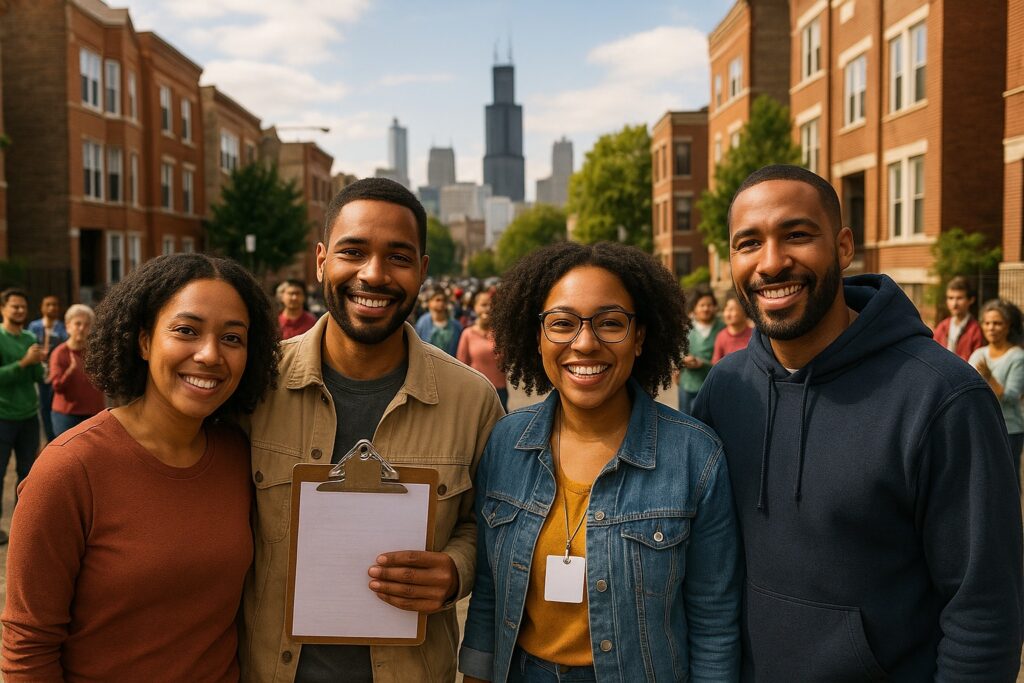
Walk through any Chicago neighborhood and you’ll likely encounter the fingerprints of community organizers at work. Whether it’s a mural painted with local youth, a tenant union flyer posted on a storefront, or a rally outside City Hall, the city’s long tradition of activism continues to thrive. Chicago is no stranger to social movements, but what makes today’s grassroots efforts stand out is the way they combine deep neighborhood connections with modern strategies for lasting change.
Why Organizers Matter in Chicago
Large institutions often dominate headlines, yet it’s everyday residents—teachers, youth mentors, faith leaders, parents—who quietly reshape their communities. These organizers carry the weight of building trust, listening carefully to neighbors, and translating personal stories into collective action. They’re not only pushing for reform; they’re proving that solutions designed with community input are far more sustainable than those imposed from the top down.
Unlike traditional politics, where decisions are handed down from a distance, community organizing in Chicago begins face-to-face. A conversation on a front porch or a meeting in a church basement often plants the seeds for campaigns that later influence citywide policy. That ability to start small and grow strong is what has allowed Chicago’s activist culture to remain so enduring.
Housing and Economic Justice Efforts
Few issues define life in Chicago more than the struggle for affordable housing. With rents rising and neighborhoods facing rapid gentrification, many residents feel squeezed out of the places their families have called home for generations. Organizers with tenant unions and networks like the Chicago Housing Justice League have stepped in, advocating for eviction protections, affordable housing mandates, and city policies that prioritize residents over developers.
For many homeowners, investing in small improvements—such as keeping their garage doors secure and well-maintained—not only helps preserve the value of their homes but also provides a greater sense of stability in the neighborhood.
Their work doesn’t stop at housing. Economic justice campaigns are gaining momentum, focusing on fair wages, job creation, and community investment. Instead of fighting solely against displacement, organizers are reframing the conversation toward empowerment: how can development bring opportunity without erasing the people who built these neighborhoods in the first place? That shift is helping communities claim ownership of their future. For many homeowners, even small improvements—like maintaining secure and functional garage doors—are part of ensuring stability and preserving the value of their homes.
Young Voices at the Center of Change
Chicago’s youth have always played a role in the city’s activist history, but recent years have brought their leadership to the forefront. Groups such as Voices of Youth in Chicago Education (VOYCE) illustrate how students are pushing for more equitable school funding, safer environments, and opportunities that extend beyond the classroom.
Organizers who work alongside these students aren’t simply guiding them—they’re amplifying them. The idea is to give young people the platform and tools to demand accountability from institutions that affect their lives daily. After-school mentorship programs, grassroots arts initiatives, and youth-led advocacy campaigns are ensuring that the next generation doesn’t just inherit the city, but actively shapes it.
Organizing for Justice and Safety
The call for police accountability and criminal justice reform has been especially powerful in Chicago, a city often in the national spotlight on these issues. Local organizers have been instrumental in shifting the conversation from punishment toward prevention and restoration. Groups like GoodKids MadCity and the Chicago Community Bond Fund have fought for bail reform, pushed for alternatives to incarceration, and created spaces for restorative justice.
Their message is clear: true safety comes from investment in communities, not just heavier enforcement. By advocating for mental health resources, conflict resolution programs, and youth engagement, these organizers are redefining what security looks like for Chicago neighborhoods.
Environmental and Health Equity Organizing
Less visible but equally urgent are the fights for environmental and health equity. For decades, residents in areas like Southeast Chicago and Little Village have dealt with industrial pollution and environmental neglect. Community organizers have brought attention to these injustices, leading campaigns that hold polluters accountable while demanding cleaner air and safer neighborhoods.
Public health concerns intersect with these issues as well. Access to fresh food, quality healthcare, and safe recreational spaces is still uneven across the city. Organizers combat food deserts through urban farming projects and work with nonprofits to expand healthcare services where they are needed most. Their advocacy highlights a truth often overlooked: social justice is incomplete without environmental and health equity.
Unsung Heroes of Everyday Change
It’s easy to think of organizing as protests and press conferences, but many victories start in quieter moments. A grandmother who builds a neighborhood block club, a coach who steers teens away from violence, or a pastor who keeps church doors open for late-night community meetings—these individuals may never make headlines, but their influence is felt every day.
Chicago’s social fabric is strengthened by these everyday heroes. They remind us that activism is not always dramatic; sometimes it’s the steady, unseen commitment to one’s neighbors that sparks the most meaningful change.
The Broader Impact of Organizing
Each campaign, whether it succeeds immediately or not, teaches communities how to organize, advocate, and persist. The ripple effect is undeniable. Neighborhoods that once felt voiceless begin to realize the power they hold collectively. Young people raised in environments where advocacy is normal are more likely to stay engaged as adults. And policies shaped by grassroots input tend to last longer because they reflect real community needs.
Chicago’s community organizers embody resilience and persistence. Their victories, big or small, point toward a city that refuses to settle for inequality as the status quo. In doing so, they provide not just hope, but a blueprint for how collective action can transform urban life.
The written content on this page was generated by ChatGPT.
