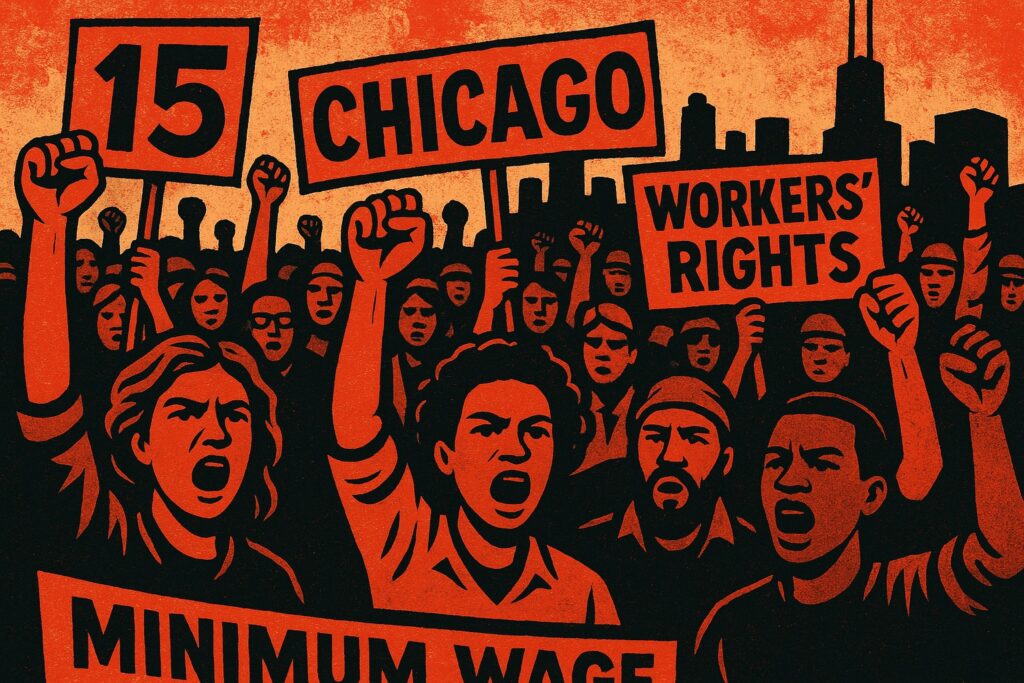
Walk through almost any neighborhood in Chicago—from the bustling corridors of the Loop to the industrial outskirts—and you can feel the pulse of a city built by workers. Every block carries the imprint of people who’ve labored, organized, and demanded to be treated with fairness and dignity. The struggle for better wages and fair treatment isn’t a recent chapter; it’s woven deep into the city’s DNA. Today, as the cost of living climbs and work itself continues to evolve, Chicago’s minimum wage and workers’ rights movement stands as both a continuation of that legacy and a new frontier in the fight for economic justice.
A Legacy Forged in Labor
Chicago’s reputation as a powerhouse city was born from its working class. In the late 19th and early 20th centuries, the city’s factories, rail lines, and slaughterhouses became symbols of both economic might and worker exploitation. The Haymarket Affair of 1886, which began as a rally for an eight-hour workday, ended in tragedy but cemented Chicago’s place in global labor history. That event, and countless others since, reminded the world that progress often requires courage and sacrifice from ordinary people who refuse to accept unfair systems.
That same spirit drives today’s conversations around the minimum wage. The tools have changed—now it’s social media campaigns, city council hearings, and union coalitions—but the heart of the movement remains the same: the belief that every worker deserves to live with dignity.
How Chicago Became a Leader in Wage Reform
When discussions about raising the minimum wage gained traction in the early 2010s, Chicago was among the first major cities to act. The City Council passed a 2014 ordinance that established a gradual path toward higher pay, taking the city well above the federal minimum of $7.25 per hour. The increases were phased in year after year, eventually reaching $16.20 in 2023 for most employers and continuing to adjust based on inflation.
These policy changes didn’t appear out of thin air. They were the direct result of sustained organizing by fast-food employees, healthcare workers, retail clerks, and janitors—people whose stories illuminated how difficult it had become to survive on stagnant wages. Movements like “Fight for $15” amplified their voices, shifting public sentiment and forcing policymakers to reckon with the realities of life in an expensive, modern metropolis.
The People Behind the Paychecks
Statistics can’t fully capture what these wage increases mean for those who live them. For many Chicagoans, a few extra dollars an hour can mean the difference between stability and crisis. Parents working two part-time jobs might finally have the means to cover rent without choosing between food and utilities. Young adults taking care of family members might have breathing room to pursue education or training that could open new doors.
Community organizations such as Arise Chicago, the Workers Center for Racial Justice, and the Chicago Federation of Labor have been instrumental in humanizing these struggles. They provide advocacy, education, and legal resources to help workers report wage theft, unsafe conditions, and other abuses. Through rallies, workshops, and storytelling, they’ve built solidarity across neighborhoods and industries, reminding the city that labor issues are also social justice issues.
Balancing Business and Fairness
Even as the minimum wage continues to rise, the debate around its economic impact remains intense. Small business owners often express concern about keeping up with labor costs, especially in sectors like food service or retail where profit margins are thin. Yet, advocates argue that fair pay doesn’t just uplift workers—it strengthens entire communities. When residents earn a livable income, they spend more locally, support neighborhood businesses, and contribute to a more stable economy overall.
Economists studying the city’s wage growth note that Chicago’s approach—raising pay in gradual increments—has helped reduce the shock to employers while still improving worker livelihoods. However, as inflation persists and automation grows, questions remain about how to sustain fairness without sacrificing opportunity.
The New Frontiers of Labor: Gig Work and Equity
The rapid rise of gig work has added complexity to Chicago’s labor landscape. Rideshare drivers, delivery couriers, and freelance workers often fall outside traditional labor protections. Without guaranteed wages, benefits, or job security, many of these workers face unpredictable income and limited recourse against unfair treatment.
City leaders have begun taking steps to address these gaps. Proposals for portable benefits, wage floors for gig platforms, and stronger contract transparency are gaining attention. Labor advocates see these initiatives as the next phase of the workers’ rights movement—a necessary adaptation to an economy increasingly defined by flexibility and precarity.
Policies That Reflect People’s Lives
In recent years, Illinois and Chicago have both taken meaningful strides toward a more equitable labor environment. The state’s ongoing workforce initiatives emphasize training, paid leave, and job safety. Meanwhile, new city policies have linked minimum wage increases to the Consumer Price Index, ensuring wages automatically adjust with inflation rather than stagnating for years between legislative actions.
There’s also growing interest in bold solutions, from universal basic income pilots to citywide equity programs targeting historically underserved neighborhoods. These experiments reflect a recognition that fair pay is just one part of a broader system—one that must address healthcare, housing, education, and transportation if true justice is to be achieved.
The Strength of Collective Action
What continues to define Chicago’s workers’ rights movement isn’t any single policy—it’s the city’s enduring belief in community power. When residents rally together, they can change more than laws; they can reshape mindsets. Faith organizations, youth groups, and unions frequently unite for shared causes, bridging divides of race, class, and occupation.
This unity has been central to Chicago’s progress. It reminds policymakers that behind every budget and ordinance are real lives affected by every decision. The strength of a city isn’t measured only in its skyline or its GDP, but in how it treats the people who keep it running.
Looking Toward a More Just Future
Chicago’s labor movement stands at a crossroads. The groundwork laid by past generations continues to guide new campaigns for fair wages, worker safety, and equitable opportunities. Yet, the path ahead is filled with challenges—global economic shifts, automation, and widening income inequality all demand creative, people-centered solutions.
Still, optimism runs deep. Chicago’s history shows that lasting change comes from persistence and collective will. Whether through legislation, union organizing, or grassroots advocacy, the fight for worker dignity is far from over. It is, in many ways, just entering a new era—one shaped not only by wages, but by a vision of shared prosperity that includes every worker, in every neighborhood.
In a city that has always celebrated hard work, the call for justice remains clear: when labor is respected, communities thrive. Chicago’s workers have proven that progress doesn’t come from waiting—it comes from standing together and refusing to be silenced.
The written content on this page was generated by ChatGPT.