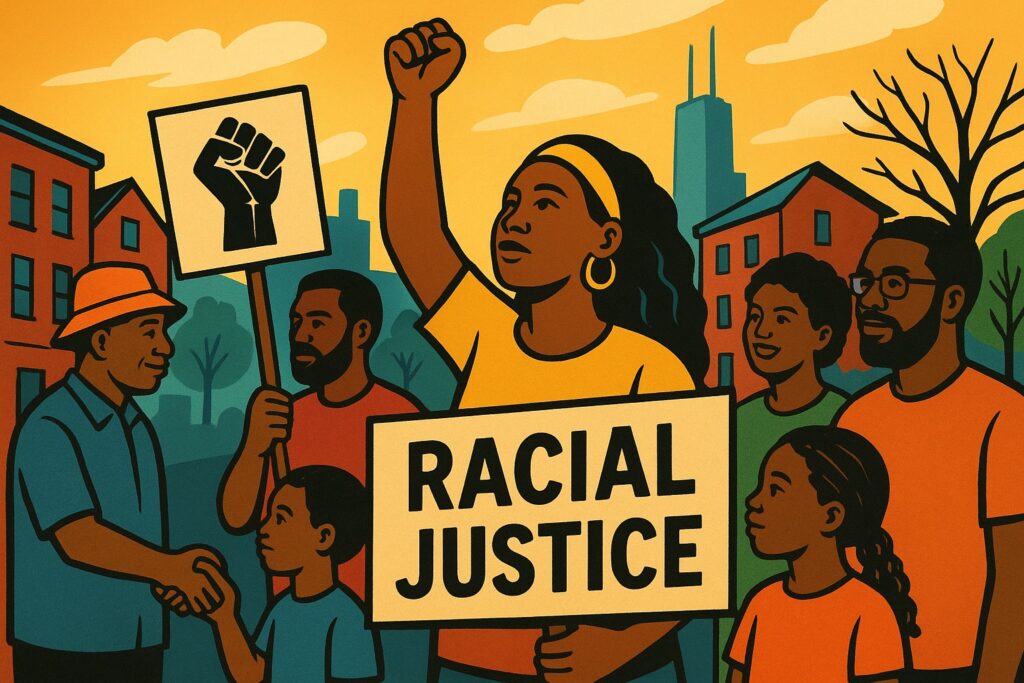
Walk through any Chicago neighborhood today, and you’ll notice more than just new murals and community gardens. You’ll see youth-led voter registration drives outside grocery stores, neighbors attending restorative justice circles in church basements, and city officials sitting at the same tables as grassroots organizers. This isn’t coincidence—it’s the result of years of coordinated racial justice initiatives reshaping the city from the ground up.
Chicago’s long history with segregation, economic disparity, and political inequality has left deep marks. Yet, those very challenges have sparked some of the most ambitious and collaborative reform efforts in the city’s modern history. The latest wave of racial justice work is focused on action, not just awareness, and its reach extends from classrooms to courtrooms, from city council chambers to small business storefronts.
From Dialogue to Tangible Change
For years, racial equity discussions in Chicago remained heavily centered on conversation—important, but often lacking measurable follow-through. That dynamic has shifted. Today’s initiatives are designed with clear objectives and timelines, emphasizing practical solutions and sustained accountability.
Partnerships now link community organizers with schools, healthcare providers, housing advocates, and private-sector leaders. The aim isn’t to offer temporary fixes but to address root causes: why certain neighborhoods have fewer resources, why residents face barriers to healthcare, and why access to economic opportunity remains uneven.
Grassroots Movements Leading the Way
While large nonprofits and city departments play a role, the beating heart of Chicago’s racial justice progress is local leadership. Organizations such as Chicago Freedom School and Black Youth Project 100 (BYP100) have built reputations for developing young leaders who know how to navigate policy advocacy as well as community outreach.
These groups don’t stop at protest organizing—they run year-round training programs in civic participation, provide mentorship to emerging advocates, and connect residents with legal assistance and emergency funding. Their work has influenced tangible reforms, such as the establishment of civilian police oversight boards, giving residents a direct say in public safety policy.
Education: Building Equity from the Classroom Up
Unequal access to quality education remains a driving force behind many of Chicago’s racial disparities. In response, initiatives like My Brother’s Keeper Chicago are targeting opportunity gaps for young men of color. These programs provide mentorship, academic coaching, and direct career pipeline opportunities.
Public schools have also begun introducing culturally responsive curricula—materials that reflect the histories, contributions, and perspectives of diverse communities. Beyond the classroom, advocacy groups are pushing for equitable funding formulas that channel more resources into historically underfunded schools, expanding extracurricular options, mental health services, and access to technology.
Housing Justice and Anti-Displacement Work
Housing has always been a central battleground for racial equity in Chicago, where the legacy of redlining still affects neighborhood demographics. Advocates are countering this history with affordable housing initiatives, tenant protection laws, and homeownership support programs aimed at first-time buyers from marginalized communities.
One noteworthy effort, Elevate Chicago, combines community-led planning with developer partnerships to ensure new housing projects offer mixed-income options. Anti-displacement policies—like property tax freezes for long-time homeowners—help residents remain in their neighborhoods as investment returns.
Closing the Racial Wealth Gap
Addressing racial inequity requires more than housing reform—it also means building wealth and opportunity. Economic justice efforts are focusing on increasing capital access for Black-owned and minority-owned businesses. The Chicago Minority Supplier Development Council has helped connect small business owners with larger corporate contracts and mentorship networks.
Local credit unions and community banks are stepping in to offer fair lending, business microloans, and financial literacy programs tailored to entrepreneurs in under-resourced neighborhoods. These tools help small businesses grow, hire locally, and circulate wealth within the community.
Health and Environmental Equity
The racial justice movement in Chicago also includes a strong health equity component. The COVID-19 pandemic exposed stark differences in access to healthcare between neighborhoods, prompting expanded use of mobile health clinics and community-based health programs. Clinics are hiring culturally competent medical staff who can better address patient needs within their cultural and linguistic contexts.
Environmental justice is intertwined with these efforts. Many Black and Latino neighborhoods face higher exposure to industrial pollutants and fewer green spaces. Local groups are taking action—organizing park cleanups, pushing for stricter air quality regulations, and creating urban gardens that provide both fresh food and gathering spaces.
A City-Wide Effort Toward Equity
What’s emerging in Chicago is a model where different sectors—government, grassroots organizations, faith communities, schools, businesses, and even local locksmith services—are working toward shared goals. This collaboration hasn’t erased disagreements, but it has created space for dialogue that leads to actual change.
From neighborhood block clubs to city council committees, residents are shaping policies that directly affect their lives. Racial justice in Chicago is no longer just an aspiration—it’s a set of strategies, programs, and measurable results that are steadily transforming the city.
Chicago’s progress reminds us that systemic change isn’t a single event but a long, sustained effort powered by committed people. These initiatives, rooted in community resilience, are laying the foundation for a more just and equitable city for generations to come.
The written content on this page was generated by ChatGPT.